Things I have Googled and Wikipediaed.

July 2nd, 2010

It might seem like personal writing and researched writing are two separate things. When I am writing, you might tell me, people want my thoughts, not Wikipedia’s. Except I find that research goes hand in hand with this kind of writing. Rather than shutting my Internet off, calling it a distraction and hammering through writing without it, I find it helps to sharpen my writing against the things I find, to use the Internet as a springboard to move my writing forward. Sure, sometimes I get distracted. But the wandering is part of the journey.

So with that in mind, here’s a list of things I’ve searched for in the process of writing a new book, tentatively entitled The Whitest Buddhist U Know. It’s not a done book–I’ll be revising, and who knows what might happen to it as I submit it to the mercy of editors. But maybe the research list will provide some enlightenment, or at least, entertainment. Behind the jump…

Read the rest of this entry »

Pema Chodron was on ABC World News Sunday

June 29th, 2010

It’s a short piece (see it online here) and not particularly deep, but a good introduction to Pema Chodron’s viewpoint for a typical Sunday-night-network-news audience. It’s nothing too surprising if you’ve read her books.

What is surprising is that it’s part of a series on interviews with “self-help” experts and writers, and that the piece specifically contrasts Buddhist thought to other self-help methods touting “the power of positive thinking.” They contrast it to a clip from “The Secret,” and highlight Chodron’s claim that happiness comes from embracing negative emotions rather than suppressing them.

The things I find interesting, and encouraging about this:

1. Mainstream media is looking at Buddhism now and trying to figure out specifically what it is–which involves looking at what it is not.
2. People are seeing that there’s another way into Buddhism. Rather than saying, “Buddhism is great because it says exactly what I’ve always believed,” they’re seeing the possibility that Buddhism is the antidote to what they’ve always believed.
3. The reputation of the shallow, materialistic New Age philosophy exemplified by The Secret seems to have gone way downhill. The news media is promoting Chodron by saying that she’s nothing like that.

All of these are good signs, in my opinion.

Work in Progress: Vulture Peak

June 24th, 2010

I’m working on a book that is, among other things, about my travels last year. Here’s a rough draft of a chapter from it that I think stands well alone. Enjoy

I hadn’t planned to travel to Nalanda and Rajgir by car. I’d been asking around Bodhgaya for bus options, but when Ali at the Hotel Tokyo Vihar heard about it, he said it was a bad idea. “There are bandits,” he said. The roads of Bihar are known for a kind of lawlessness, it’s true. I’d read the book Rude Awakenings by Ajahn Sucitto and Nick Scott, a story of a Buddhist pilgrimage that fell apart when the two men were robbed in Bihar–actually, on the exact road that I would be traveling between Bodhgaya and Rajgir. That’s why I ended up hiring Ali to drive me to Rajgir.

The land of Bihar is mostly flat, but there are a few dramatic hills and small mountains punctuating the horizon. I watch them go by from the window of Ali’s car. We listen to Bollywood music as we drive; Ali has a few collections of current Bollywood hits, and he switched the CD a few times.

One of these mountains is Vulture Peak. The scriptures tell us that Shakyamuni Buddha delivered some of his most pivotal teachings on Vulture Peak, including the Heart Sutra and the Lotus Sutra. It’s a major pilgrimage point for Japanese Buddhists of the Nichiren sect for that reason.

It’s also in the poorest state in India, Bihar. This state has been known as the wild frontier of India for a while, though the lawlessness has subsided in recent years. Still, I’m aware. While my dad was afraid I’d die at the border of Pakistan, I was afraid I’d die in Bihar. But I’m relatively safe. Ali is friendly, but soft-spoken, quiet by nature. It’s actually a comforting presence, being in the car with him, like I don’t feel the need to fill up the air with chat. We’re just enjoying a ride together.

As much as I’m afraid of Bihar’s reputation, there’s also a deep love I feel for the place. I remember talking to Vineet back in Delhi, hearing his pride in calling Bihar his home state, the history and opportunity for greatness. There is a sign in Bodhgaya that says, “We walk on ground where Buddha walked. Wherever you go in the world, say it with pride: I AM BIHARI.” I take the sign’s advice and say it with pride, pile it on to the list of things I say with pride: I am Nebraskan, I am American, I am Detroit, I am Canadian, I am Bihari.
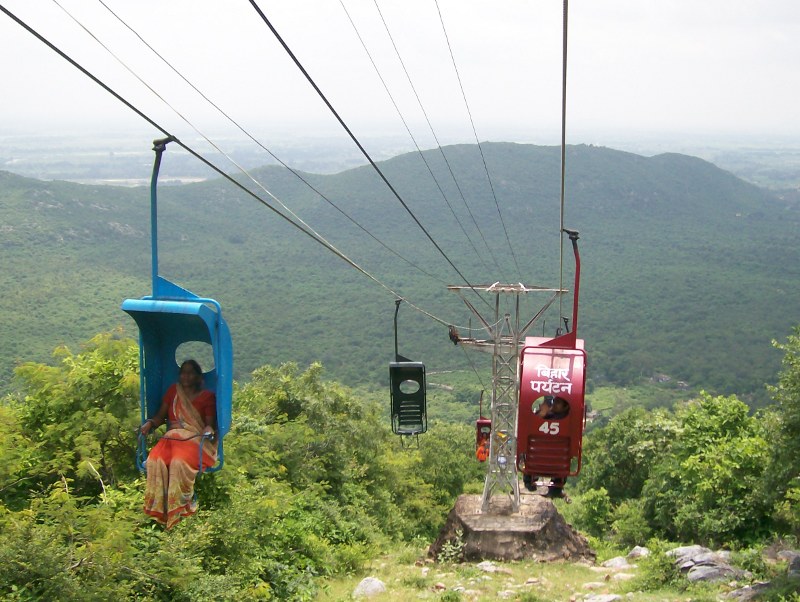
Vulture Peak Ropeway, Rajgir

We reach the foot of Vulture Peak, get out of the car and buy tickets for the ropeway. I’ve been on ropeways before, in Haridwar, but this is different. The Haridwar ropeway had carriages for six people. The carriage would arrive and stop, and people would file in. Then the door would be secured, and the tram would move on.

This ropeway was just a chair lift. The single chairs are constantly moving, and passengers must stand where the chair will scoop them up. We wait in line behind a large Indian family. Their teenage daughter is nervous. She steps to the line with the incoming chair, then jumps away at the last minute. They coach her in Hindi, but she still doesn’t want to get on the chair. Three empty chairs pass her before she gets the nerve to get on one. The rest of her family follows.

I step up. I’m determined not to make a nervous spectacle of myself. The chair pulls in, and I am ready. I hop on and it lifts me off my feet. As I make the steady climb, I reach for the latch that’s supposed to safely (or semi-safely) belt me into the seat.

I only find a broken hinge, a bent piece of metal where the latch should be. I glance at the chairs coming down; they all have solid bars against their seats.

Ali’s in the chair coming up behind me. I turn to him, and he smiles and waves. He doesn’t know that I’m in peril. But it’s a peril against a stunning landscape, like a James Bond movie, so I decide I need pictures. Still, at each moment I look down, I make a quick mental calculation. If I fell right here, I might get caught by that bush and not hurt too much. If I fell from here, I’d die. It’s not too far right now; I could cut my losses and take a fall right here.

To be honest, I’m probably not in much danger at all. The chair remains relatively upright, I have both feet on a rest and bars to hold onto if the ride gets bumpy.

But that doesn’t stop my imagination from running away with me. I’m going to die. Here in Bihar. Here on my way up Vulture Peak. Without seeing the Shanti Stupa. I’m never going to see America again. But then I get a sense of peace. If I die here, I die on ground where Buddha walked. Maybe I’ll be reborn here in Bihar. There are worse things that could happen.

Of course, I reach the top of the lift in one piece. There are a few steps to go up to the stupa.

Just below the stupa, there’s a field of gravel. Dozens of people are milling around in the gravel, drawing designs, moving gravel into little piles. I see a word written in the sand: AMERICA. I wonder who wrote it. Perhaps a pilgrim like me scratched it there, wishing for blessings for his homeland. Or perhaps it was written by a Bihari university student, hoping the Bodhisattva of Compassion would help him get an immigrant visa, a job at GM, a house in the suburbs of Detroit. To me it’s a reminder: this is your home.

AMERICA

On the Golden Rule

June 19th, 2010

The case for believing that all religions are the same often is supported by the claim that all major religions teach the Golden Rule. However, I think it’s notable there are differences in the way this Golden Rule is phrased. Some phrase it as “Do unto others as you would have them do unto you,” and some phrase it as a compound negative–“Do not do unto others as you would not have them do unto you.”

The interesting correlation I see is that religions with a positive Golden Rule tend to be proselytizing religions. “I am glad that I was converted; therefore, I should try to convert others.” Religions with a negative Golden Rule tend to be non-proselytizing. “I wouldn’t like it if someone tried to convert me away, so I shouldn’t try to convert others away from their religions.”

The only anomaly in this case (with the versions taken from here) is Jainism, which is a non-proselytizing religion that has a positive Golden Rule.

As I said in my previous post, what’s interesting about different religions is the differences in what they say about compassion. If someone is on the wrong path, to what extent is it compassionate to correct them, and to what extent is it compassionate to let them be? The different religions of the world, and their differences, ensure that we’ll keep looking at this issue. We won’t all come to the same answer, and that’s for the best.

Retelling an old story

June 4th, 2010

I’m devoting my June to a bigger writing project, so my updates here will be even more sporadic than usual, and perhaps out-of-context bits of what I’m writing. Hey, if you haven’t, check out the funky essays I wrote for Monkey Goggles. But for now, a fragment that surprisingly came out in my writing today.

The story of Hui-neng is one of the most famous ones in Chinese Buddhism. Zen master Hung-jen, the Fifth Patriarch of Zen announced that anyone who would be considered heir to his position should write a poem on the wall of the monastery. Everyone thought Shen-hsiu, his most esteemed follower, would succeed at this. Shen-hsiu was the most educated, had appeared as a guest on a handful of talk shows, and had a nice little fan club. He carefully thought through which one of his greatest hits he’d write to seal the deal.

He wrote a poem, and it wasn’t bad. It was like the kind of thing Buddhist-inclined office workers can put on their Buddhist-quote-a-day calendars to read during their coffee breaks and feel inspired. Shen-hsiu knew what worked, and he went there.

One illiterate monk, Hui-neng, heard about the poem, and realized it was incomplete and pithy. Sure, it was pretty much true, and not a horrible thing to say, but Hui-neng had a response, being present for this moment, that came directly from his own insight. He asked a friend to write a follow-up poem on the wall.

Seeing the follow-up poem, the Zen master knew it came from Hui-neng, and that it demonstrated deeper wisdom. He called Hui-neng to a private meeting, and declared him the Sixth Patriarch–then told him to run, because Shen-hsiu’s fan club would rip him apart.

Luckily, we don’t live in feudal China anymore. We live on the Internet, where the dissenting voices are merely subject to being told they are worse than Hitler. If Hui-neng were here today, I think he might keep a blog. He might call out the Dharma celebrities whenever they’re full of crap–which, let’s face it, we all are sometimes.

Is compassion central to all religions?

June 1st, 2010

There’s been some discussion of a New York Times essay by the Dalai Lama. Some of the contention has come from a broader claim made elsewhere, or the claim implicit in the title “Many Faiths, One Truth”–which, of course, may have just been a headline writer’s misguided summary.

The essay itself doesn’t claim that all faiths believe in the exact same truth. Instead, it argues that four major religions, Christianity, Buddhism, Islam and Hinduism, all have compassion as a “central” or “core” element.

So what do we do with this broad pronouncement? Does this mean that anything presented as a religion, including Scientology, Branch Davidians, Heaven’s Gate, etc., are all equally compassionate? I would hope not. Does this mean that people who are not religious don’t have compassion as a central guiding principle? I would hope not as well.

It’s problematic because of the idea of a “center” or “core.” The Buddha taught that an individual’s center is impossible to define, using the analogy of a cart, which I update to the analogy of a car. Is “the car” the same as the tires? The body? The engine? It isn’t. You can replace those parts and it’s still considered the same car. A person is like that, the Buddha says. We swap out parts of the self and become different people, but there’s still a kind of continuity. What, at its core, is this continuity? In a sense, any name we give to it will be not quite right.

The name “Buddhism” refers to a vast web of stuff. Buddhism includes temples and books, chanting and prostrations, Tibet, Sri Lanka, Thailand, Japan, Detroit. One of these many elements included is compassion. If we swapped out all the other stuff and replaced it, would the compassion alone still make it Buddhism?

It actually reminds me of the study of literature. When you read a book for a class, you can expect the question, “What is this book really about?” Your answer comes in the form of an essay, essay meaning “try,” an attempt to pin down a core knowing that an equally intelligent person might say it’s really about something else.

Over time, literary theory developed particular ways of thinking, systems used to point in a direction for the “really about” question. Feminist theory tends to answer, “The story is really about the different perceptions of men and women.” Marxist theory tends to answer, “The story is really about the struggle of the working class.” Perhaps if we follow the Dalai Lama’s advice here, we develop a kind of “compassion theory.” We look at any religious teaching or text and find a method of interpretation so that we can faithfully say, “This story is really about compassion.”

Why this worries me: schools of theory can tend to put us in blinders, paying only selective attention. When we learn about another religion, are we paying attention to what we’d like to think it’s saying, what will confirm what we already hope to believe about it? Are we going to say as soon as we hear the word “compassion,” “Yup, I get it. Say no more. We have compassion in my religion too”?

If you want to study compassion theory and study it well, my advice is to follow the avenue of questioning. Even if compassion is at the core of religions, it’s because the founders of those religions each had something precise to say about compassion. They started religions because they wanted to correct people’s misguided definition of compassion, because what people would like to think about compassion, according to these sages, was incorrect. So if you want to know that Christianity is about compassion, figure out precisely what the Gospels say about compassion, and how it differs from what the Dhammapada says about compassion, what the Quran says about compassion, what Star Trek says about compassion. Don’t be afraid to take a stand and say when something is wrong.

The question “What is compassion?” is too big for one religion to answer. Maybe to accept diversity of religions is to accept that different answers are an essential part of it. We won’t see that if we assume all religions, and all religious people, are all saying the same thing.

The Lament of the Introverted Extrovert

May 17th, 2010

I’ve always thought there was something lacking about the personality typing of “extroverts” and “introverts.” While there are people who are primarily one or the other, I’ve always found myself on a middle ground–not a tempered balance, but a set of strong traits of one kind or the other. Then I’ve met some people who I consider the opposite. I’ve called myself an “introverted extrovert” and the friends with differing tendencies “extroverted introvert,” but the order of the words is kind of arbitrary.

The two major factors I see are the ways we get energy and the way we process information/express emotion. Some people get more energy from being alone, and some get more energy from being around other people. I think of it this way: Suppose you say, “I’ve had a really tough week, and this weekend, I just need to unwind.” Do you define “unwind” as “stay home with my shoes off and turn off the phone” or as “go out and make some noise”? The other factor is inward or outward expression and processing. When you have to think about something, do you think out loud?

So my type, the Introverted Extrovert, thinks out loud. When the music’s great, we have to dance. When we find something funny, we laugh long and hard. We’re not usually shy or afraid of expressing ourselves to people. And yet, we’ll shut down if we don’t get enough time alone. Essentially, we don’t need other people.

The Extroverted Introverts I know are kind of puzzling. They have high hopes for being around other people. They want to impress people. Sometimes their way of dancing, joking or laughing seems like a big show, like something they’ve carefully planned because they want someone else to see it. Other times, it’s just guarded, reserved, acknowledging that something is funny, but they don’t want to make a fool of themselves. They get really depressed when they spend too much time alone.

When I told one friend about this theory, he said that it seemed self-serving–like I was giving myself the category that made sense and the other people “the wrong one.” Maybe. I wouldn’t trade off, that’s for sure. And it’s part of my temperament. I like approval from other people, but I don’t see the point in craving it.

But I have realized one weakness of the I-E. When I’m reading, and encounter something funny, I laugh out loud, and sometimes people ask what I’m reading or what’s so funny. Sometimes I want to share and sometimes I don’t; I wasn’t laughing for you. So when there are other people in the room, I find it hard to get writing or reading done, not if those people are in any way with me. People at another table in a coffee house are fine, but houseguests or relatives, no.

Which is why I feel like I didn’t get anything done this weekend. We had houseguests, and while I was tempted to take off for a coffee house, I didn’t. I just sat at my computer, not getting anything done.

Reading about invented languages

May 12th, 2010

This book by Arika Okrent is pretty cool. I’m only halfway through it, but it talks about the growth over time of pre-planned language systems. Some were designed for the purpose of practical communication, and some were designed for fictional universes.

I’ve always loved foreign languages, but I’m afraid I don’t have much aptitude for them. (Evidence for the first claim: the first rock record I ever owned was 99 Luftballons, which had one side in English and one in German. Evidence for the second: I studied French for nearly eight years, and when I overhear people speaking French in public I understand almost nothing.) So I don’t think I could join Okrent on her journey of studying Esperanto and Klingon, but I’m enjoying the ride.

Something struck me in the part about visual languages. One became used in the Ontario Crippled Children Centre for those patients who could not speak. Previously, their communication had been isolated to a practical matter, a way to signal caregivers that they needed something. I’ll quote: “Kids whose communicative worlds had been defined by the options of pointing to a picture of a toilet, or waiting for someone to ask the right question, started talking about a car trip with a father, a brother’s new bicycle, a pet cat’s habit of hiding under the bed.”

This may be why I grew disillusioned with phrasebooks the times I’ve traveled. A phrasebook gives you a set of problem-solving indicators of needs, and a handful of conventional phatics (such as “hello” or “thank you”) without social context. Sure, you can use them, but you don’t learn the language, and you don’t learn to listen or anticipate what someone might say back to you. At best, you get a momentary smile of amusement at the foreigner who learned to say “Buenos dias” or “Ni hao.”

That’s why I’m a little moved by the communication of the speechless children in Ontario. Their frustration wasn’t from being unable to demand a drink or announce that they needed to pee. Their frustration was that the interesting world around them–the cars, the bicycles, the cat under the bed–had no way to be shown.

I saw this quote on Twitter a few weeks ago, and it speaks to what I’m thinking about here: “I truly believe that one of the most wonderful and reverent things you can say to another human being is ‘look!'”–Kathleen Dean Moore.

The times in India when I was trying to talk to someone who spoke little English, I felt the same thing. I could get what I wanted easily enough–but what I really wanted to say was, “Look at that cow walking over the bridge” or “The people selling corn on the roadside remind me of my home in Nebraska.” If I were writing a phrasebook, the first phrase I’d want to know is “Look!”

And yet, sometimes that wasn’t an obstacle. You can say more through a glance and a gesture. It takes practice, but when it works, it’s also a wonderful and reverent thing to say.
Traffic in Varanasi

Something I Learned on the Internet

April 15th, 2010

On the Internet, you can take any pithy, semi-inspirational quote and make it sound better by attributing it to the Buddha, the Dalai Lama, or Gandhi. It doesn’t matter whether the Buddha, the Dalai Lama, or Gandhi actually said it. In fact, it doesn’t even matter if you can spell “Dalai Lama” or “Gandhi”!

This is obviously one of the great things about the Internet, but it doesn’t go far enough. I think that the name of anyone famous should be acceptable. Here, some examples:

“Work like you don’t need the money, love like you’ve never been hurt, and dance like no one’s watching.” –George Washington

“Approach love and cooking with reckless abandon.” –Mother Teresa

“If you can’t love yourself, how the hell are you going to love someone else?” –Ralph Waldo Thoreau

“You’re never fully dressed without a smile.” –Albert Einstein

“It’s nice to be important, but it’s more important to be nice.” –Friedrich Nietzsche

“Don’t worry, be happy.” –Saddam Hussein

See how easy it is to spread the wisdom? Look for an explosion of inspiration, coming soon to an Internet near you!

Buddha: the Myth and the Medicine

April 10th, 2010

This week, PBS aired a documentary (which you can view–free and legal–on their website) of the life of Buddha. I’d definitely recommend it to anyone with any interest in Buddhism. It doesn’t exactly cover brand-new territory; the Buddha’s life has been the subject of many excellent books. But the perspective on it was interesting in a number of ways.

put your hands up for Bihar

The story of Buddha’s life came to us through centuries of the oral tradition, somewhere between myth and history. Any modern retelling of Buddha’s life has to make a strategic decision about how to present the parts of the legend that seem more legendary than others. Some of these are part of the birth and childhood legend–his mother had a dream foretelling his birth, he spoke moments out of the womb, a tree stopped moving its shadow to keep him protected. Others come from his life and teaching, performing miracles.

And I think this is a particularly tricky balance. For many contemporary followers of Buddhism, the core teachings are an antidote to magical thinking. You change things by changing your own habits and efforts, not relying on an angel or ghost to help you out. Buddhism’s compatibility with scientific findings is a definite plus. But sometimes this tempts us to say that we know the story of Buddha’s life obviously didn’t happen the way the myths tell us. It’s as if we know Buddha better than his contemporaries did, and it’s a little condescending to the ways of thinking that most humans have had through history.

I like the way PBS’s The Buddha dealt with this. Many parts of the Buddha’s life were shown through stylized animations, giving a sense of story-telling through cave paintings, and it spent little time refuting or confirming the myths, just letting them speak for themselves. Whether we doubt them or believe them isn’t addressed. As poet Jane Hirshfield says in the documentary, “Sitting here in a room having had a cup of coffee, having taken it out of a beautiful blue and white porcelain mug…what could be more miraculous than that? Everyday life around us is already so implausible and so glorious but what need for further miracles. And that’s the teaching of the Buddha. That’s the miraculous teaching of the Buddha.”

There’s a famous story of the Buddha in which he responds to a question about the creation of the universe. Buddha uses an analogy; imagine someone shot by a poisoned arrow. A doctor tries to remove the arrow, but the victim won’t let him. “Before you pull out the arrow,” he says, “I want to know who shot me. Was it a man or a woman? Were they old or young? Why were they shooting at me?” Buddha explained that this is our predicament when we focus too much on metaphysical questions.

I imagined a sequel to this story. After the doctor pulls the arrow out, the victim still has poison in his bloodstream. Fortunately, the doctor knows the antidote to the poison and gives it to him to drink. “Who made this antidote? Where did he live? Is it true that he worked miracles? Is it true that he could stop a rampaging elephant with his mind?”

I don’t know which parts of the Buddha’s story are true and which were added after the fact. But that makes it no different than any other story. Surely we all have stories that we tell one way, but other people who were present for the same event tell differently. Why would a story from 2600 years ago be different? And yet I also believe that these stories are part of the antidote, part of what’s been passed over the centuries to alleviate the suffering in the world. If I want the antidote, I can at least play along with the myth. I know it’s more rewarding to watch Buffy if I can play along and believe that vampires are real, and more fun to watch The Simpsons if I play along and believe that Krusty the Klown’s face is on every product ever sold to kids. So if the Buddhist path will be more rewarding–and will be a better antidote to the poisons–if I believe that business with the elephant, then I’ll go for it.